Comparing Additive Manufacturing to Injection Molding  

Choosing the right manufacturing process is one of the most critical decisions in product development. Both additive manufacturing and injection molding are powerful options, but they have different strengths. Knowing when to use each one can be the difference between a smooth launch and a series of expensive delays.

This isn't an either/or choice. The real question is which process is right for your project at its current stage. Let's look at the practical differences between the two and how to decide which path to take.

parallax image

Why the Comparison Matters

Additive manufacturing and injection molding offer unique advantages depending on where you are in the development cycle. Early on, you might need speed and flexibility to iterate on a design. Later, you'll need repeatability and cost-efficiency for production.

Making the right choice involves balancing speed, cost, accuracy, and compliance. A clear understanding of each process helps you create a product development plan that gets you to market faster, with a design that's ready for full-scale production.

Additive Manufacturing Additive Manufacturing

Additive manufacturing, especially with Carbon DLS technology, has changed the way engineers approach design and iteration. It builds parts layer by layer directly from a digital file, which offers several key advantages.

Injection Molding Injection Molding

Injection molding is the established standard for high-volume production, particularly in regulated industries like medical devices, where consistency, repeatability, and validated processes are critical.
Cost & Timeline Considerations

 Your budget and timeline will heavily influence your choice. Additive manufacturing has a low startup cost and fast turnaround, but a higher cost per part. This makes it ideal for prototyping and short production runs.

Injection molding has a much higher startup cost and a longer lead time, but the per-part cost is significantly lower as volume increases. The break-even point where molding becomes more cost-effective than additive depends on the part's complexity and material, but it's often in the range of thousands of units.

For many projects, a blended approach works best. You can start with additive to iterate and validate the design quickly, then move to bridge tooling to test for manufacturability, and finally scale into production molding with confidence.

Materials Comparison

One of the most common questions we hear is, "Do additive parts perform like molded thermoplastics?" With modern materials, the answer is often yes, with some trade-offs. While additive resins aren't a direct 1:1 replacement for their thermoplastic counterparts, many are engineered to mimic their key properties.

For example, several of Carbon's resins provide performance comparable to common thermoplastics:

  • ABS: RPU 70 and UMA 90 offer similar stiffness and toughness to ABS, making them great for functional prototypes of enclosures and housings.
  • Nylon (PA): RPU 130 can be used for applications requiring the toughness of unfilled nylon, while filled grades like EPX 82 offer higher stiffness.
  • Polycarbonate: RPU 130 and EPX 82 deliver good strength and heat resistance, and IND 405 provides optical clarity similar to PC.

The key is to understand the specific requirements of your application. While an additive material might not match every property of a thermoplastic, it may be more than sufficient for the functional needs of your part, especially during the prototyping and validation phases.

Tolerance & Accuracy Comparison

When it comes to dimensional precision, additive and molding offer very different performance. While Carbon DLS can achieve tolerances of around ±0.003 inches, injection molding can reliably hold ±0.001 inches or even tighter for demanding applications.

For many prototypes and functional parts, the accuracy of additive is perfectly sufficient. It allows you to test form, fit, and function with confidence. However, when a project demands the highest level of precision for critical components, especially in medical devices, injection molding remains the standard.

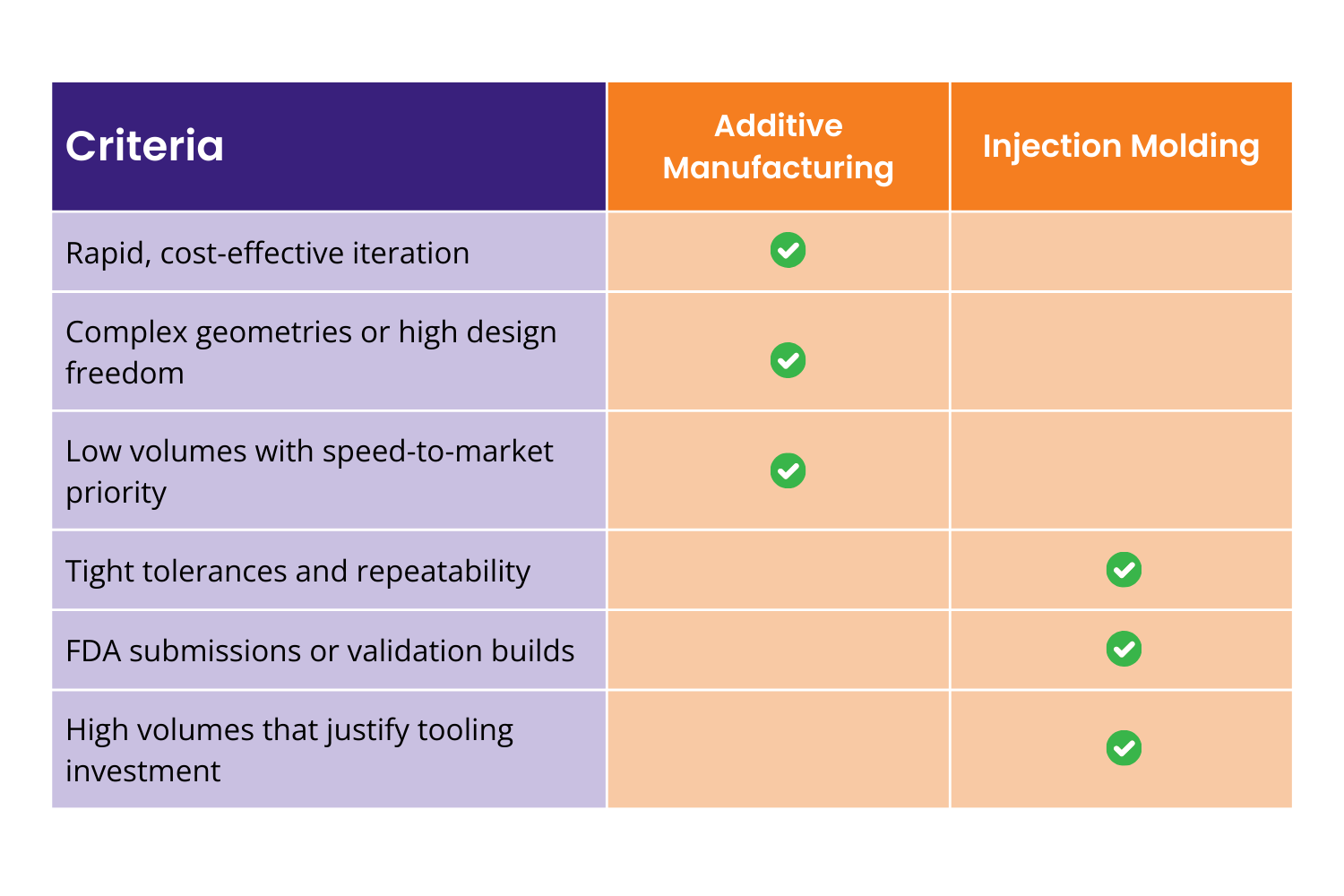
When to Choose Additive vs. Injection Molding


Here's a simple way to think about it:

additive im

Aprios' Role in Helping You Decide 


Because Aprios offers both Carbon Additive Manufacturing and Injection Molding in-house, we aren’t pushing you toward one solution. Instead, we help you:

  • Iterate in additive
  • Validate in bridge tooling
  • Scale in production molding

Our goal is simple: make sure your product development path is faster, smoother, and smarter.

Ready to Find the Right Path?

Aprios helps you navigate the decision between additive and molding with confidence.

Upload your CAD files and we'll provide initial feedback on manufacturability (covered by MNDA).