2 min read

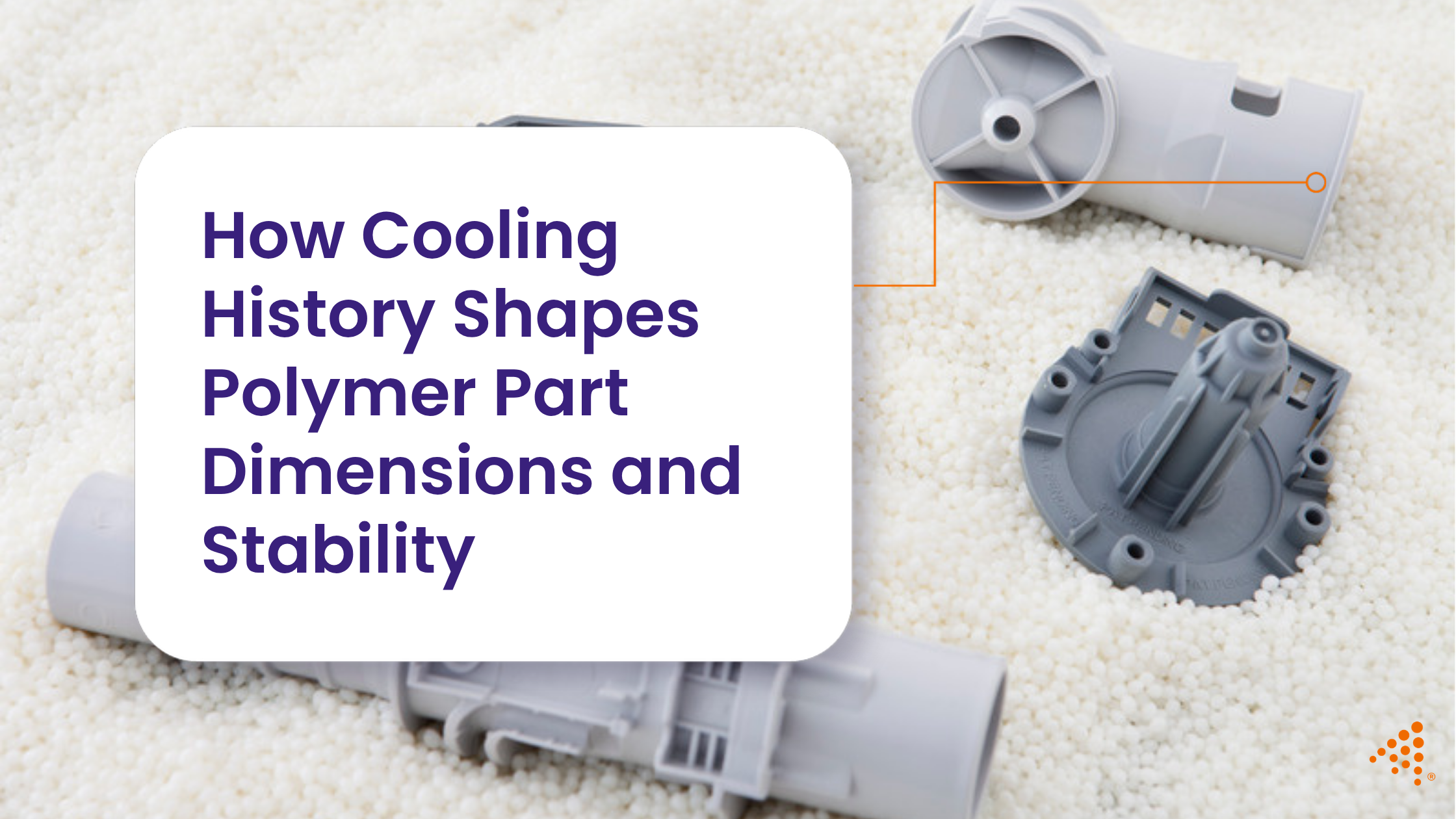
How Cooling History Shapes Polymer Part Dimensions and Stability

How Cooling History Shapes Polymer Part Dimensions and Stability

How Polymers Change as They Cool

As molten polymer cools inside the mold, it doesn’t solidify all at once. It moves through distinct thermal regions, each affecting how the final part forms.

At high temperatures, the material flows freely. As it cools, molecular movement slows and structure begins to form. Once it drops below key transition points, the material locks into its final shape.

That progression determines how much the part shrinks, how stress develops, and how stable it remains after molding.

The Three Thermal Regions

Polymers transition through three stages during cooling.

In the melt region, the material behaves like a fluid with freely moving chains. In the transition region, mobility decreases and internal structure begins to form. In the solid region, molecular movement largely stops and the geometry becomes fixed.

The speed at which the material passes through these regions directly affects the final outcome.

Differences Between Material Types

Amorphous and semi-crystalline polymers respond differently during cooling.

Amorphous materials transition through the glass transition and tend to shrink uniformly with relatively low variation. Semi-crystalline materials go through both glass transition and crystallization, leading to higher and more directional shrinkage.

This difference shows up clearly in dimensional control. Amorphous parts are typically more predictable, while crystalline parts require tighter control of temperature and cooling conditions.

How Cooling Rate Influences Shrinkage

Cooling rate plays a central role in how the internal structure develops.

Slower cooling allows more crystallization in semi-crystalline materials, increasing shrinkage. Faster cooling can trap internal stress, which may reduce immediate shrink but lead to instability later.

In real use, uneven cooling creates differences across the part, which often show up as warpage or distortion.

Pressure and Temperature Working Together

Pressure helps control how tightly the material packs as it cools.

During packing, higher pressure compresses the polymer and reduces shrinkage. If the gate freezes too early, pressure can no longer reach the cavity, leading to localized defects like sinks or voids.

As cooling continues after packing, the remaining shrinkage is defined by the thermal path the material follows.

Molecular Orientation and Relaxation

Flow during filling aligns molecules near the surface while the core remains less oriented.

If cooling is rapid, that orientation becomes locked in, creating internal stress and directional shrinkage. If cooling is slower, molecules have more time to relax, which improves stability but increases cycle time.

Balancing these effects determines how the part holds its shape over time.

Measuring Shrinkage

Shrinkage is calculated by comparing the mold cavity size to the final part dimensions.

Shrinkage (%)=Cavity Size−Part SizeCavity Size×100\text{Shrinkage (\%)} = \frac{\text{Cavity Size} - \text{Part Size}}{\text{Cavity Size}} \times 100Shrinkage (%)=Cavity SizeCavity Size−Part Size​×100

Amorphous materials typically fall in a lower shrinkage range, while semi-crystalline materials shrink more and often differently depending on direction.

Tracking this data helps connect processing conditions to final part geometry.

Key Thermal Properties in Practice

Several thermal properties guide process development.

Glass transition defines when a material gains or loses stiffness. Melting point determines when crystalline regions fully liquefy. Crystallization temperature influences how structure forms during cooling. Heat deflection temperature indicates how the part will perform under load at elevated temperatures.

Together, these properties define how a material behaves during both processing and use.

Controlling Dimensional Stability

Maintaining consistent dimensions requires controlling how the material cools and how pressure is applied.

Packing pressure is optimized to maintain density, cooling systems are balanced to keep temperatures uniform, and cavity pressure is monitored to ensure consistency.

Linking in-process data to post-mold measurements closes the loop, making dimensional outcomes predictable rather than reactive.

The Aprios Approach

Thermal behavior drives everything from shrinkage to long-term stability.

By controlling how a material moves through each transition stage, the process produces parts that hold their shape consistently, not just at ejection, but long after they’ve cooled and settled.

How Process Data Helps Solve Injection Molding Problems

How Process Data Helps Solve Injection Molding Problems

Injection molding problems are often solved the same way they start—with adjustments.

How Melt Temperature Affects Injection Molded Parts

How Melt Temperature Affects Injection Molded Parts

In injection molding, temperature is one of the most important variables to control.

How Cooling Rate Affects Warpage and Part Quality in Injection Molding

How Cooling Rate Affects Warpage and Part Quality in Injection Molding

In injection molding, cooling is the final step in the process—but it has a major impact on the final part.