
2 min read
Cp stands for Process Capability Index.
It’s a statistical measure that shows how much natural variation your process has compared to the allowed tolerance range.
In simple terms, it answers:
How tight is your process compared to how tight it needs to be?
If the variation is small relative to the tolerance, Cp is high. If the variation is large, Cp is low.
No molding process produces identical parts every cycle. Small variations in material behavior, temperature, and machine response create a natural spread in dimensions or weight.
Process capability metrics quantify how controlled that variation is and whether it stays within specification limits.
Again, Cp measures how wide the process variation is compared to the allowed tolerance.
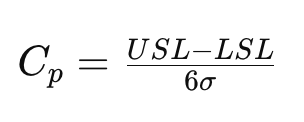
It compares the total tolerance range to the natural spread of the process, defined by six standard deviations.
A higher Cp means the process variation is tight relative to the tolerance. A lower Cp indicates the process spread is too wide, increasing the likelihood of defects.
Cp assumes the process is perfectly centered, so it reflects potential capability rather than actual performance.
In real production, processes don’t stay perfectly centered. The average can shift due to material changes, temperature drift, or tool wear.
Cpk accounts for that shift by measuring how close the process mean is to the specification limits.

This captures both variation and centering. Even with a tight process, a shifted mean can reduce capability and increase scrap.
Cp and Cpk tell different parts of the same story.
A high Cp with a low Cpk indicates a stable but off-center process. A low Cp and low Cpk point to excessive variation and poor control. When both are high, the process is both precise and properly centered.
The difference shows up in how consistently parts meet specification across production.
Capability values are tied directly to process performance.
A Cp or Cpk below 1.0 means the process cannot reliably meet tolerance. Around 1.33 indicates a capable process under normal variation. Higher values reflect tighter control and lower defect rates.
For critical applications, higher thresholds are used to ensure long-term consistency.
Two processes can have identical variation but produce very different outcomes depending on where the mean sits.
If the process is shifted toward one specification limit, more parts fall outside tolerance even if variation is low. Re-centering the process can improve capability without changing the variation itself.
In molding, this often leads to tool adjustments rather than process changes.
Capability studies require sufficient data to reflect true process behavior.
Measuring a single part or a small sample doesn’t capture variation. Larger sample sizes provide a clearer picture of how the process performs over time.
These results are used during validation to confirm that the process can consistently meet dimensional requirements.
Once established, Cp and Cpk become ongoing indicators of process health.
Tracking these values over time helps detect drift, identify emerging issues, and maintain consistent quality. When capability begins to drop, it signals that the process or tool needs attention.
Capability is treated as a continuous measurement, not a one-time result.
Cp and Cpk are tied back to process data, including DOE results and cavity pressure profiles. This creates a direct connection between machine behavior and dimensional outcomes.
That feedback loop keeps the process stable, centered, and capable of producing consistent parts over time.

Variation in injection molding is the gap between what a process intends and what actually happens. It cannot be eliminated, but it can be defined,...

A Parallel Approach to Product Development Concurrent engineering replaces the traditional step-by-step development model with a parallel workflow....