Why Tool Qualification Determines Injection Molding Success
Why Tool Qualification Matters in Injection Molding In injection molding, success often starts before production even begins.
2 min read
A molding process is only as stable as the machine running it. If the press can’t support the required pressure, shot size, or clamp force, variation shows up immediately.
That limitation carries through the entire process, affecting fill consistency, packing behavior, and final part quality.
Machine selection starts with three core requirements.
Clamp force keeps the mold closed under pressure.
Shot size determines how much material the barrel can deliver consistently.
Injection pressure and speed control how the cavity fills.
Each one must comfortably exceed process demands, not just meet them.
Clamp force prevents the mold from opening during injection.
If it’s too low, the mold separates slightly and creates flash. If it’s too high, it can accelerate tool wear and reduce venting effectiveness.
Clamp requirements are based on projected area and cavity pressure:
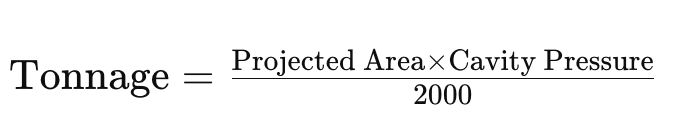
In practice, this keeps the mold sealed without overloading the system.
The barrel should operate within a balanced range.
Running too small a shot relative to barrel capacity increases residence time and can degrade material. Running too large a shot reduces pressure stability and consistency.
A typical target is using about 30–80% of the machine’s shot capacity. This keeps melt behavior stable from cycle to cycle.
The machine must deliver enough pressure and speed to fill the cavity under validated conditions.
If the press is near its pressure limit, it loses control over flow. If injection speed is insufficient, the material may cool before filling completely.
For demanding applications, higher-performance machines provide better control over velocity and pressure response.
Other factors influence how well the mold runs on a given press.
Tie-bar spacing must accommodate the mold size. Nozzle compatibility affects how material transfers into the tool. Stroke and daylight determine whether the mold can open fully for part ejection.
Machine type also matters. Electric presses offer precise control, while hydraulic systems provide higher force for larger molds.
Problems often trace back to running too close to machine limits.
Undersized clamp force leads to flash. Oversized shot capacity can degrade material. Limited injection pressure causes inconsistent filling.
These issues don’t come from the process itself, but from the machine’s inability to support it.
The machine should operate comfortably within its capabilities while the process operates within its validated window.
That alignment keeps pressure, velocity, and temperature control stable, allowing the process to perform as intended.
Machine selection is treated as part of process validation.
Each mold is matched to a press based on clamp requirements, shot size, and injection performance. Compatibility is verified before production, and setup conditions are documented for traceability.
That alignment ensures the machine supports the process rather than limiting it, leading to more consistent results across every cycle.
Why Tool Qualification Matters in Injection Molding In injection molding, success often starts before production even begins.
Why Does Additive Manufacturing with Carbon DLS Come with a High Price Tag? If you've ever dabbled in 3D printing or looked into it for your...
How time in the barrel affects material integrity and process stability What Residence Time Means Residence time is how long material stays inside...